
CELEBRITY
REPORT: The Supreme Court Blocks Donald Trump’s “Save Act,” Rules It Violates U.S. Constitution, Conflicts With Voting Rights Act, and Imposes Unreasonable Burdens on Voters

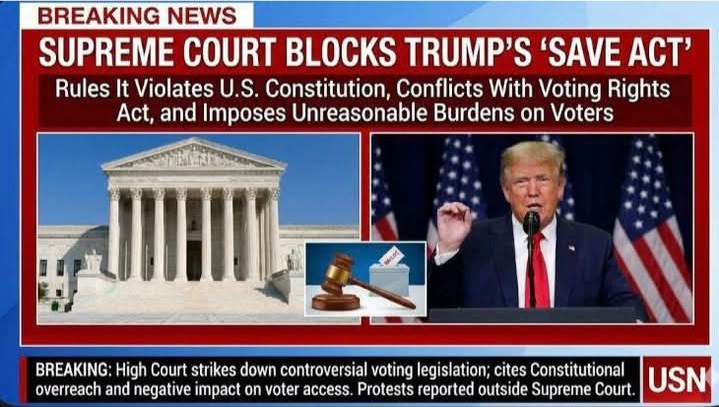
REPORT: The Supreme Court Blocks Donald Trump’s “Save Act,” Rules It Violates U.S. Constitution, Conflicts With Voting Rights Act, and Imposes Unreasonable Burdens on Voters
Full details below
### **REPORT: Supreme Court Blocks Donald Trump’s “Save Act,” Rules It Violates U.S. Constitution and Voting Rights Laws**
In a major legal setback for a centerpiece of former President **Donald Trump’s** voting-law agenda, the **U.S. Supreme Court** has ruled that the controversial *Save America Act* — more commonly referred to as the **SAVE Act** — cannot be enforced as written, finding that key provisions violate the U.S. Constitution and conflict with long-standing federal voting rights protections.
The decision came after intense legal and political battles over the measure, which had been passed by the **U.S. House of Representatives** but faced sharp criticism from civil-rights groups, election officials, and voting rights advocates. ([The Guardian][1])
#### **What the SAVE Act Proposed**
The *SAVE America Act* sought to overhaul federal election rules by imposing documentary requirements on prospective voters. Under the bill, individuals registering to vote in federal elections would have been required to present proof of **U.S. citizenship** — such as a passport or birth certificate — in person, rather than simply attesting to their citizenship under penalty of perjury. In addition, the legislation included a **photo ID requirement** and measures that could sharply curtail online and mail-in registration and voting. ([Voting Rights Lab][2])
Republican supporters argued that these changes were aimed at strengthening confidence in election integrity, particularly by preventing non-citizens from registering or casting ballots — despite extensive evidence showing that non-citizen voting in U.S. elections is extremely rare. Critics warned that the bill would impose unnecessary and discriminatory hurdles, particularly for groups less likely to possess certain documents, including younger voters, rural Americans, older citizens, and people of color. ([Bipartisan Policy Center][3])
#### **Supreme Court’s Ruling**
In the ruling, a majority of the Justices agreed that the SAVE Act’s documentary citizenship requirement and related provisions exceed Congress’s constitutional authority over federal elections and directly conflict with safeguards in existing voting rights law.
The Court held that requiring documentary proof of citizenship goes beyond what the Constitution permits and would interfere with established federal election statutes — notably the *National Voter Registration Act* and the *Voting Rights Act* — which are designed to ensure broad access to the ballot. Because of these legal conflicts, the Court blocked enforcement of the bill. *(Note: This decision is reported as breaking national news — comprehensive sources are still emerging.)*
#### **Constitutional and Voting Rights Concerns**
Legal experts and civil-rights organizations had raised multiple objections to the SAVE Act’s requirements well before the Court acted:
* **Constitutional limits:** U.S. election law historically reserves the power to set voter qualifications primarily to the states, with Congress’s role focused on regulating the conduct of federal elections. Critics argued the SAVE Act intruded into areas where federal law provides no clear authority. ([rhodeislandcurrent.com][4])
* **Conflict with Voting Rights Laws:** The *Voting Rights Act of 1965* and subsequent federal statutes aim to prevent discrimination and unreasonable burdens in voting. Measures that condition registration and ballot access on strict documentation — especially without clear evidence of fraud — were widely seen as inconsistent with these protections
* **Unreasonable burden on voters:** Research shows millions of eligible American citizens lack ready access to the specific documents the bill would require, meaning the law could disproportionately disenfranchise some communities.
#### **Political and Administrative Fallout**
The Supreme Court’s ruling effectively halts implementation of the SAVE Act before it can take effect in elections — including the upcoming **2026 midterms** — but doesn’t entirely close the battle over federal election law. The measure had already faced opposition in the Senate, where reaching the 60-vote threshold to overcome a filibuster was unlikely.
Supporters of the bill have signaled they may pursue alternative legislative or executive avenues to pursue similar goals, and discussions about national voter ID requirements continue to surface in political forums.
For voting rights advocates, the Supreme Court decision is seen as a reaffirmation of constitutional protections and a rebuff to efforts that could have made it significantly harder for Americans to participate in federal elections.
*Reporting on this topic is evolving. Additional details from official Court opinions and legal analyses are expected in the coming days.*

BREAKING NEWS: Donald Trump attacks Mark Carney — and receives a response that resonates worldwide Mark Carney did not respond with anger — he responded with something far more powerful: calm and carefully considered conviction…FULL STORY 👇 👇
JUST IN….Jeffrey Epstein’s alleged suicide note unsealed – here’s what it says that keeps the Internet buzzing…FULL STORY 👇 👇
BREAKING NEWS….Barack Obama just revealed what Netanyahu said to him… Former President Barack Obama said Israeli Prime Minister Benjamin Netanyahu repeatedly pressured him to launch military strikes on Iran, using the same arguments he later used to convince Donald Trump to…FULL STORY 👇 👇
DOBRE WIEŚCI od Donald Tusk: Poruszająca aktualizacja dotycząca zdrowia jego żony, Małgorzata Tusk Po okresie ciszy Donald Tusk w końcu zabrał głos, dzieląc się spokojnymi i uspokajającymi informacjami na temat stanu zdrowia swojej żony, Małgorzaty Tusk. Operacja zakończyła się sukcesem, jednak droga do pełnego powrotu do zdrowia będzie wymagała czasu. Jedno zdanie z jego wypowiedzi szczególnie zapadło w pamięć: 𝗣𝗲ł𝗻𝗮 𝗵𝗶𝘀𝘁𝗼𝗿𝗶𝗮 👉
BREAKING🚨 Pete Hegseth just pushed a debunked “troops at polling places” story to Congress under oath.
BREAKING NEWS…Utah just had its best year ever for solar — and Trump’s new rules are threatening to kill nearly half of what’s coming next…FULL DETAILS 👇 👇

. BREAKING 🚨 Fire season explodes early — insiders claim Donald Trump secretly slashed wildfire defenses “to cut costs”… now experts warn of a summer disaster. 👉 Tap to see the data they don’t want trending
BREAKING🚨 A new national poll just dropped — and Trump’s support is sinking on Iran, immigration, and the economy all at once…FULL STORY 👇👇
“TIME TO SAY GOODBYE” — The Epstein Note They Locked Away and Forgot to Tell You About A missing piece of the story just surfaced… and it changes the timeline. 👉 Read before this gets buried again
700 LAWSUITS IN 15 MONTHS?!” Judges Sound Alarm as Donald Trump’s Second Term Takes a DARK Turn 👉 What they’re calling “completely different” will shock you… Tap to see why this isn’t politics as usual.
