
NEWS
15 Hidden Facts About Diana’s Wedding: The Last One Will Change Everything You Thought You Knew (For Full Information, Check Link In Comment👇🏻👇🏻)

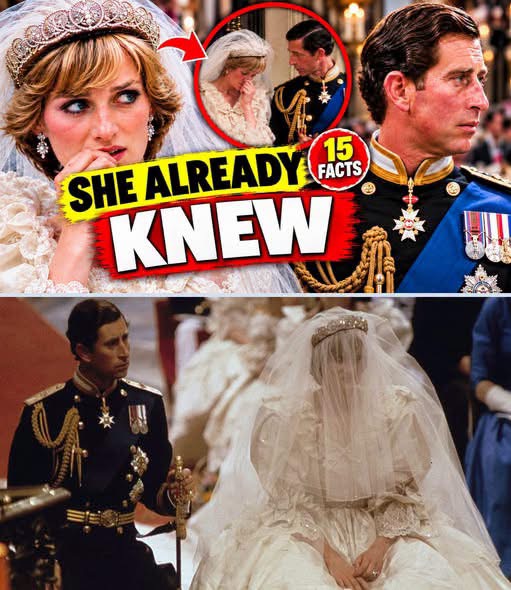
On July 29, 1981, Diana Spencer entered St. Paul’s Cathedral wearing an ivory silk dress, a train that seemed to go on forever, and an expression that the whole world learned to recognize. It wasn’t just nervousness; she was 20 years old. Standing before her was the man who would one day be king. Behind it all, a family steeped in centuries of tradition. Outside, London had stopped, and in millions of homes people didn’t see a young woman entering a church, they saw the beginning of a fairy tale. But that day, the most viewed in Diana’s life, holds details that almost never appear when we look at the images again. Some are small, others completely change the way we understand that wedding, because beneath the silk, the flowers, the music and the greetings from the balcony, there was a very young girl entering the most guarded institution in the world. And the last piece of information doesn’t talk about a dress, a jewel or a cake, it talks about what that wedding really meant to Diana.
The first fact is that the wedding did not come from a long and peaceful relationship; it came from a silent haste. Charles and Diana had only known each other for a short time when the engagement was announced on February 24, 1981.
Diana already belonged to a social world close to the royal family. Her older sister, Sarah Spencer, had previously dated Charles. Diana knew the codes, the surnames, the country houses and the way duty was discussed in British aristocratic circles. But knowing that world was not the same as being prepared to be absorbed by it. Diana was 19 when the engagement was made public. Charles was 32. The age difference was not the only contrast between them. He had been under the weight of being an heir for years. She had lived through an adolescence marked by her parents’ separation, boarding schools, changes of home, and a deep need to feel chosen and safe. Suddenly, that young woman who worked with children and shared a flat in London became the future Princess of Wales. The country saw a perfect image: a young, elegant, shy bride from an aristocratic family. The press saw the story they had been waiting years for. The monarchy saw a future mother for the heir to the heir. But very few people seemed to wonder if Diana was prepared for everything that was coming her way.
That commitment was celebrated as a response. Actually, it opened up a lot of questions. The first one was simple and at the same time impossible to answer from the outside: How well did they really know each other? In the engagement interview, the journalist asked them if they were in love. Diana responded with a smile.
Charles added that phrase which became a shadow over history.
“Whatever love means.”
At the time, many took it as an awkward response, typical of Charles’s style. Over the years, the phrase ceased to sound innocent, not because a single line can explain an entire marriage, but because we now know how much weight each word carried in that relationship. The wedding was going to be grand, but the private space between the two was much smaller than the world wanted to believe.
And that brings us to the second detail. The wedding date was chosen for a Wednesday, not a Saturday. It seems like a minor detail, but it says a lot about the magnitude of the event. July 29, 1981, was not a date chosen for a normal family wedding. It was selected within a calendar of state, security, television, travel, and protocol. London had to be ready. The cathedral had to be ready. The routes of the carriage, the guests, the musicians, the military, the photographers, and the media from around the world had to fit together precisely.
For the royal family, a wedding wasn’t just a wedding; it was a display of continuity. At a time when the monarchy needed a renewed image, Queen Elizabeth II represented stability. Charles represented the future. Diana brought youth, beauty, naturalness, and an immediate connection with the public. In just a few months, she became one of the most photographed women on the planet.
That morning, hundreds of thousands of people filled the streets of London. Millions watched the ceremony on television. Worldwide audience estimates put the number at hundreds of millions. It wasn’t simply a British ceremony; it was a global event. For those who watched it live, the memories remain vivid: the flags, the hats, the shouts, the packed balconies, the children perched on their parents’ shoulders. There was a sense of national joy, almost of relief. For a few hours, Great Britain seemed united around a young woman smiling from a carriage. But Diana couldn’t hide behind the spectacle. She had to walk down that aisle, she had to say those vows, she had to enter, at 20 years old, into a life where her every move would be scrutinized for decades.
The third point has to do with the location. Many people remember the wedding as if it took place at Westminster Abbey, where so many royal ceremonies are held. But Charles and Diana married at St. Paul’s Cathedral. The choice was not accidental. St. Paul’s had a mu

15 Hidden Facts About Diana’s Wedding: The Last One Will Change Everything You Thought You Knew (For Full Information, Check Link In Comment👇🏻👇🏻)

Anna Wallace’s Love Affair With King Charles Was Much Nastier Than You Thought (For Full Information, Check Link In Comment👇🏻👇🏻)

🚨 IS HE CHEATING ON HIS GIRLFRIEND? 👀 These Intimate Photos Have Fans Questioning His Loyalty!

Kirsten Dunst and Jesse Plemons Just Stepped Out Together Looking Like This — But There’s a Catch”

WAIT… DID TRAVIS KELCE REALLY STEP OUT LOOKING LIKE THIS WITH ANOTHER WOMAN?! 👀 These Shocking Photos Have Fans Asking QUESTIONS — What’s REALLY Going On?

Tom Brady, 49, proudly showed off his new 19 year old boyfriend as they shared a passionate kiss at the beach, after revealing his past experiences with his Ex. Gisele Bündchen had changed his perspective on relationships with women

5 Hours Ago! King Charles Issues Major Announcement on Princess Charlotte’s HEARTBREAKING Incident: ‘Oh God, My Granddaughter Has…’”

EMERGENCY — 3 MINUTES AGO! Sarah Ferguson , wiping away tears, ran straight into the Royal Court to announce the tragedy surrounding Prince Andrew after his titles were revoked. Princess Beatrice broke down, holding eugenie as though the world had fallen apart. The sisters cried out in agony: “No… Father, why must it end like this?…’” (For Full Information, Check Link In Comment👇🏻👇🏻)

Lil Nas X Spotted in Public for the First Time After Gender Transition — Fans Can’t Believe the Transformation!

Tom Holland, 30, in London with new girlfriend, 35, after recent breakup with Zendaya, 30

It has been reported that adult film star Lily Phillips was diagnosed with AIDS after sleeping with 10,000 men in 24 hours. See details of her trending vedio here…👇
